

Join our daily newsletter At The Bell to receive exclusive market insights
Tracing its history back to the Bronze age, tin was first used and mined in regions like early Turkey and Mesopotamia around 3500 BC.

Since that time its popularity has surged a number of times in line with mining, processing and technology breakthroughs.
And according to the experts it is tin’s time again.
Speaking at the 2026 International Tin Conference in Seville earlier this year, Mariano Pero, chairman of the International Tin Association (ITA), said the metal is no longer sitting quietly in the background of industrial supply chains.
He told the large audience tin is increasingly being recognised as an essential material, providing economic resilience, technological competitiveness and industrial security.
The reasons for this growing attention are clear.
Tin remains essential to electronics, semiconductors, digital infrastructure, advanced manufacturing and energy systems.
The ITA recently added another string to tin’s bow, noting it is emerging as a promising material in several hydrogen-production technologies, from green hydrogen generated through water splitting to turquoise hydrogen produced through methane pyrolysis.
Recent research is highlighting how tin’s properties could support more efficient hydrogen generation and create new opportunities for the metal in future energy systems.
Mr Pero also noted the industry is approaching a decisive period with increasing demand countered by supply apprehension.
The continued development of AI and data-centre infrastructure represents another relevant demand thematic because of the advanced electronic systems required throughout computing and data-centre infrastructure.
Beyond electronics, tin has established applications across tinplate, chemicals and alloys, while broader electrification continues to increase the deployment of electronic systems across transport, renewable-energy infrastructure and industrial applications.
While tin is gaining a significant position as a critical mineral there are growing concerns about supply risks with around 65% of global primary tin output coming from just three countries—China, Indonesia and Myanmar.
And with the growing geopolitical landscape, buyers are now looking for stable political and mining friendly jurisdictions to supply tin for now and in the future.
One of those areas is Namibia – widely regarded for its mineral riches and its reputation as one of Africa’s most stable, transparent and premier mining localities.
The Southern African nation, already a global leader in the supply of uranium and gemstones, is emerging as a regional producer of tin, anchored primarily by the historic and expanding Uis tin mine in the Erongo region.
Tin was first discovered at Uis in 1911 and operated on various scales through the 20th century. It became the world’s largest hard-rock open-cast tin mine before closing in 1990 due to depressed global tin prices.
In June Andrada Mining reported the Uis mine delivered record tin production of 286 tonnes during the first quarter of the 2027 financial year, a 20% increase from the corresponding period last year.
That is a great sign for Highland Metals’ (ASX: HLM) and its neighbouring Uis project.
Namibia benefits from world-class infrastructure including the deep-water port of Walvis Bay which is connected to the Highland Metal’s Uis project by a network of sealed roads. Walvis Bay connects Namibia with buyers from three important trading hubs including Europe, Asia and the Americas.
This strategic location is combined with the stability of a mining sector which places Namibia in high regard as a country that can readily act as a safe supply chain for tin consumers globally.
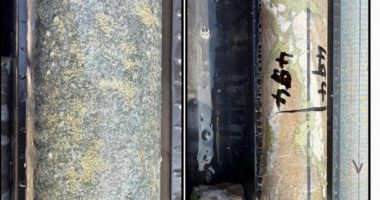
Highland is also attracting the attention of tin market watchers and has already uncovered significant tin and polymetallic mineralisation at the Uis project.
The company recently completed a detailed technical review of the tin mineralisation potential at the Uis project. This review brought together an extensive body of exploration information from Uis and demonstrated why the company believes tin represents an important part of the project’s broader value proposition.
The OP area is particularly significant. Systematic trenching tested an approximately 2.2-kilometre pegmatite system and returned previously reported tin intersections including 2.0 metres at 4,985 parts per million (ppm) tin, with an internal metre at 8,340 ppm tin, together with a broader interval of 6.0 metres at 1,014ppm tin.
Those results are complemented by significant previously reported tin mineralisation at PS, DP and K9.
At DP trenching tested an approximately 700-metre main pegmatite and returned broad intervals including 13.10 metres at 930 ppm tin and 8.32 metres at 838 ppm tin.
“When we consider these targets alongside the historical surface-sampling and drilling datasets, the extent of the existing tin exploration information across Uis becomes much clearer,” Highland’s executive director, Gino D’Anna, said.
Tin also gives Highland exposure to important structural trends across the global economy. Its role in solder makes the metal directly relevant to semiconductors, advanced electronics, computing infrastructure and electrification.
“The combination of multiple mineralised pegmatite targets, significant previously reported tin grades and an extensive existing exploration database provides Highland with a strong platform from which to evaluate the Uis tin opportunity alongside the project’s broader critical-minerals potential,” Mr D’Anna, said.
The company is planning to ramp up exploration activity at its flagship asset after a project-wide geochemical soil sampling campaign was completed across the EPL 7626 licence, within the broader Uis project.
The survey was designed to identify extensions of mineralised pegmatites associated with the Uis tin mine and generate priority targets for follow-up exploration.
Results will now be integrated with geological, structural, geophysical and hyperspectral datasets to refine targets for follow-up mapping, trenching and drilling.
Elsewhere, work completed at licence EPL 7345, together with further planned exploration at EPL 7345 and EPL 8535, highlights the potential for significant size and scale across the broader Uis project.
Located in prime tin country in a proven and stable jurisdiction, with strong prices for the metal continuing, reinforces the strategic value of Highland’s growing exposure to tin and associated critical minerals at Uis.
“Highland sees tremendous opportunities at Uis focused on unlocking the tin potential of the Uis project and with previous exploration delivering positive results,” Mr D’Anna, said.
“Highland is excited about the next stage of exploration at Uis. It is hard to overlook the fact that the Highland Uis project lies directly along strike and shares licence boundaries with the nearby operating Uis tin mine.”
Trading Economics says tin is trading up near 10.81% and is obtaining strong underlying support.
Elsewhere, Mordor Intelligence estimates the 2026 global tin market at 439.89 kilotons, expanding from a 2025 value of 429.24 kilotons with 2031 projections showing 497.1 kilotons, growing at 2.48% CAGR over 2026 to 2031.
Tin is sure shining bright for Highlands Metals and Namibia.



-1200x645-380x200.jpg)