




Records on top. Regime turn underneath. Three U.S. indices closed at record highs into a holiday-shortened week. The Philadelphia Semiconductor Index ripped +5.53% to a fresh peak. Solar tagged near double digits, Airlines posted +7.41%, Metals & Mining ran +8.01% — three risk-on flares lit up the single-name leaderboard.


Memory took the next headline. Micron (MU) breached a $1 trillion market cap on a UBS upgrade; SK Hynix crossed $1T the same Tuesday, joining Samsung in memory’s $1T cohort.
Beneath them, the energy complex came apart in parallel. Oil Services -5.24%. Energy sector -4.27%. Oil & Gas E&P -4.07%. Brent collapsed more than 7% to a one-month low after Tehran agreed to reopen Hormuz thirty days post-deal — the geopolitical premium that built April’s leadership evaporated in seventy-two hours.
The breadth bid changed character, too. SPY ground +1.20%, QQQ led at +2.52% on the Semis bid — but IWM’s flows collapsed from a 52-week peak just thirty days ago to the lower quartile, while equal-weight RSP locked in peak inflows. The crowd didn’t follow size into the bounce; it dispersed across equal-weight.
When the bell reopened Tuesday, capital didn’t return to the same trades — and by Thursday’s record close, the leadership map had quietly redrawn itself. Let’s break down where the money actually went.
The Theme: From Cyclicals to Rate-Sensitives
Two catalysts repriced the week. First — the Iran deal cleared the runway. Trump signaled progress, Tehran agreed to reopen Hormuz thirty days after signing, and Brent collapsed more than 7% to a one-month low. The geopolitical risk premium that built Energy’s leadership in April evaporated in seventy-two hours, and the sector that led last quarter went into free-fall.
Second — the AI cycle re-staged itself. Micron (MU) printed +19.3% Tuesday on a UBS upgrade to $1,625 and breached a $1T market cap; SK Hynix crossed the same threshold the same session. The Philadelphia Semiconductor Index ripped +5.53% to a record. Memory, not compute, took the headline. The mega-cap Tech tape ran with it — but the flow data didn’t.
The flow tape ran with both: Energy and Regional Banks collapsed off 52-week peak inflows; Consumer Discretionary, Real Estate, and Health Care absorbed the bid. Health Care, Communications, Financials, and Utilities still sit in the lower PE quartile — capital can keep rotating without paying up. Money is doing what it does at a regime turn: leaving the consensus, finding cheap where the next story can develop.
Sector Rotation: The Defensive Handoff

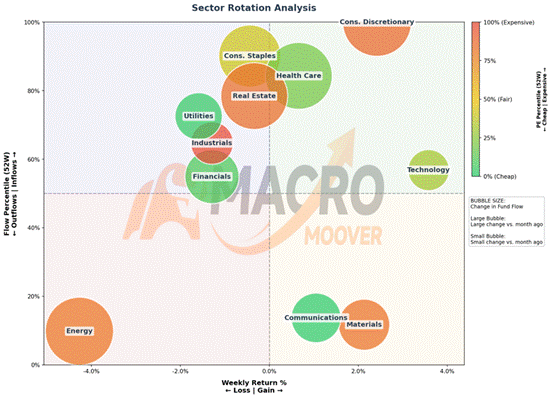
Consumer Discretionary (XLY) sits firmly in the upper-right conviction quadrant — the largest bubble on the chart, with flows accelerating from the lower quartile to the maximum reading possible in thirty days. Amazon (AMZN), Tesla (TSLA), and Home Depot (HD) absorbed institutional positioning paired with strong weekly gains. Consumer resilience plus rate-relief — clean and unambiguous.
Real Estate (XLRE) is the cleanest early-accumulation read on the board. Flows rebuilt from the absolute floor to a 52-week peak while the sector closed slightly red. Pair lower oil with falling forward rate expectations and the bid has a thesis.
Technology (XLK) is the counterintuitive read. Tech posted the strongest weekly return on the sector board — Microsoft (MSFT), Apple (AAPL), Nvidia (NVDA) — yet flow percentile sat mid-range and slightly faded over thirty days. Price moved on the Memory print. Flows did not follow. The mega-cap bid carried the headline number; conviction did not extend.
Energy (XLE) completed the cleanest exit on the chart. Flows collapsed from a 52-week peak a month ago to the absolute floor, paired with the worst weekly return on the sector board. Exxon (XOM), Chevron (CVX), and ConocoPhillips (COP) all saw capital leave at scale. The geopolitical bid is gone; last quarter’s leadership hasn’t been re-rated lower yet — the flow data says capital isn’t waiting.
Industry Rotation: Pain Trades and Silent Accumulation
The sector rotation gives the macro frame. The industry chart is where the real alpha lives. Several divergences ran in opposite directions this week — and each carries a different message.
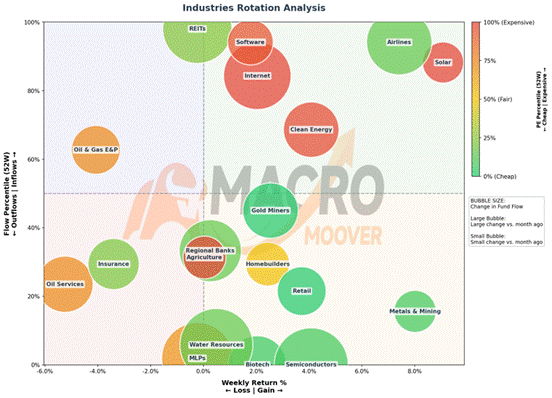
Airlines (JETS) sit at a 52-week peak inflow paired with the third-strongest return on the board, behind Solar and Metals & Mining — flows rebuilt from the lower quartile to the chart’s ceiling. Delta (DAL), United (UAL), and American (AAL) absorbed accumulation as lower fuel costs reshape unit economics. PE still in the lower quartile — the rotation can extend.
Solar (TAN) and Software (IGV) are the chart’s two most crowded setups — and this week’s tape split them. Solar paired peak flows with the strongest return on the board and PE at the absolute extreme — First Solar (FSLR), Enphase (ENPH), SolarEdge (SEDG) — positioning fully consensus, valuation has nothing left.
Software is the subtler read. Flows near a 52-week peak, weekly return only +1.78% — but Thursday alone delivered nearly three points and reclaimed the 200-day moving average. The catalyst was earnings-led: a Snowflake (SNOW) beat lit up the AI-software cohort, with Oracle (ORCL), Microsoft (MSFT), ServiceNow (NOW), and Palantir (PLTR) riding the bid. The peak-flow read wasn’t a trap — it was pre-positioning. Spring’s valuation compression may finally be ending.
Semiconductors (SMH) ran a textbook short-cover pattern — strong weekly return paired with flows at the absolute floor. Nvidia (NVDA), AMD, and Broadcom (AVGO) all gained without institutional sponsorship. Returns without conviction — until flows build, the bounce sits without an institutional bid behind it.
Oil Services (OIH) posted the worst return on the entire chart with flows draining toward the floor. Schlumberger (SLB), Halliburton (HAL), and Baker Hughes (BKR) all bled — the energy complex unwind made specific. Not paused. Leaving.
The Bottom Line
The handoff happened in a single week. Hormuz killed the energy trade. The Memory print pulled Semis without flows behind it. Capital left the cyclical-plus-banks consensus and moved into rate-sensitive defensives and consumer.
Three indices closed at record highs. The flow tape underneath them did not look like a melt-up — it looked like a regime turn that finished before most of the Street noticed.
Where flows lead, price tends to follow. Flows moved. Price hasn’t. Yet.

Join the discussion. See what’s trending right now on Australia’s largest stock forum and be part of the conversations that move the markets.
The material provided in this article is for information only and should not be treated as investment advice. Viewers are encouraged to conduct their own research and consult with a certified financial advisor before making any investment decisions. For full disclaimer information, please click here.
General ETF disclosure: Before investing in an ETF, you should read both its summary prospectus and its full prospectus, which provide detailed information on the ETF’s investment objective, principal investment strategies, risks, costs, and historical performance (if any). You can find prospectuses on the websites of the financial firms that sponsor a particular ETF, as well as through your broker. Investment returns will fluctuate and are subject to market volatility, so that an investor’s shares, when redeemed or sold, may be worth more or less than their original cost. ETFs are subject to market volatility and the risks of their underlying securities, which may include the risks associated with investing in smaller companies, international securities, commodities, fixed income, and more. An ETF may trade at a premium or discount to its net asset value (NAV).