


As we pivot into the second half of 2025, the artificial intelligence supercycle is entering its next, more sophisticated phase. The initial gold rush for raw computational power is giving way to digital alchemy, where the abstract potential of AI is transmuting into tangible economic value.
Listen to the HotCopper podcast for in-depth discussions and insights on all the biggest headlines from throughout the week. On Spotify, Apple, and more.
This article is disseminated in partnership with Moomoo Insights. It is intended to inform investors and should not be taken as a recommendation or financial advice.
The AI narrative is no longer just ‘to build bigger models.’ It’s broadening to the building of smarter, more efficient systems that rewire the global economy one token at a time. Tokens are units of data processed by AI models.
So every query, every generated image, every line of code is a transaction in this new economy, measured in the cost and speed of its constituent tokens.
Generative AI: From model building to scaled application
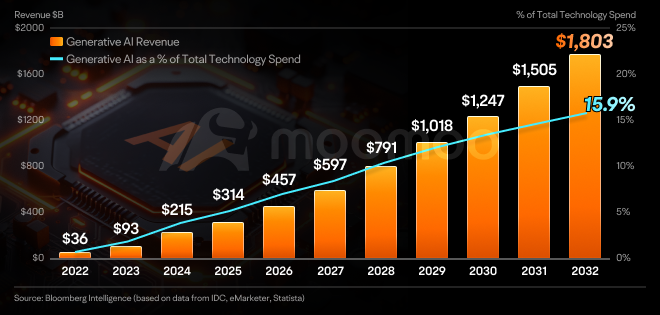
Generative AI is becoming a dominant technology, with long-term revenue projections reaching between US$1.3 trillion and US$1.8 trillion by 2032.
For the second half of 2025, the key trend is the sector’s pivot from brute-force pre-training of ever-larger models towards more efficient inference and reasoning capabilities. This shift is driven by the need for a clearer return on the massive capital outlays of the past two years and the emergence of highly efficient open-source models that are democratising access to powerful AI.
The focus is moving from simply creating AI to applying it, with the value of each model now being judged on its efficiency in generating each token of output. This is fueling explosive growth in the market for AI agents and copilots, while the expansion of AI to devices such as PCs and smartphones will open entirely new revenue streams.

Data centres: relentless, insatiable demand for infrastructure
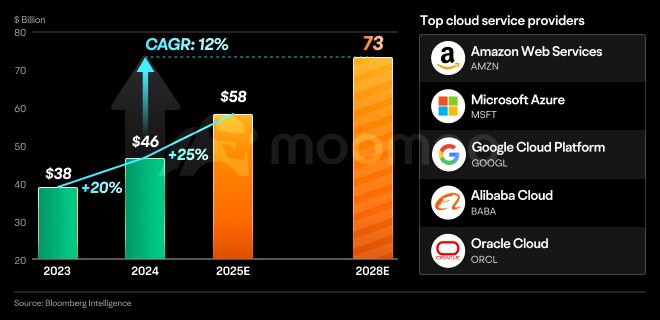
The data centre market remains the physical engine of the AI revolution, with infrastructure equipment sales projected to grow at a 12% compound annual rate to reach US$73 billion by 2028. The outlook for the rest of 2025 is defined by relentless demand, with hyperscaler capital expenditures expected to remain robust.
Next-gen data centres – AI factories – are built to process trillions of AI tokens at unprecedented speed. However, this insatiable demand is creating significant bottlenecks, particularly around power and land availability. Global demand for data-centre capacity could rise at an annual rate of more than 20% through 2030, with demand for AI-ready capacity growing at an even faster 33% per year. This has forged a new, symbiotic relationship between the tech and energy sectors, with data-centre growth now increasingly constrained by grid capacity, driving investment in new power solutions from renewables to the restart of nuclear reactors.
Semiconductors: split between boom and recovery
The global semiconductor market is forecast to continue its strong growth in the second half of 2025, with projections for the full year pointing to an 11% increase in sales to a record US$697.1 billion, keeping the industry on its path to a US$1 trillion valuation by 2030.
However, this top-line number masks a deep, persistent divergence within the industry. The market is clearly split into two distinct cycles: A structural, AI-driven boom and a traditional, slower, cyclical recovery. Demand for high-performance GPUs and high-bandwidth memory, essential for processing trillions of AI tokens, continues to surge.
In contrast, traditional segments such as automotive and industrial electronics, which are more sensitive to broader economic conditions, face a much slower recovery from inventory buildups and softening demand. This bifurcation means the ‘supercycle’ is not lifting all boats equally.
A critical theme for the rest of this year will be the high-stakes technology transition to next-generation manufacturing processes, with the industry closely watching the race between TSMC’s 2nm node and Intel’s competing 18A process, as the performance of these new platforms will be measured in their efficiency and throughput of AI tokens.
What this means for investors
Australian investors can best (and directly) participate in the AI and semiconductor supercycle through the U.S. market, which hosts the industry’s dominant players. Investments can be segmented across the AI value chain.
- The primary and most direct strategy is to invest in core hardware that enables the AI revolution.
- A secondary, crucial strategy is to target the generative AI software and models layer.
- A third strategic layer focuses on AI applications.
- A final, more indirect strategy is to focus on the energy and materials sector.
While Australia lacks large-scale chip manufacturing, a domestic investment strategy can be built around the local ecosystem that supports and benefits from the global AI trend.
- The infrastructure backbone (picks and shovels): The most robust and direct local strategy is to invest in data centre infrastructure.
- Local innovators and enablers: A higher-risk, higher-reward strategy involves investing in local technology innovators.
Understand the risks and rewards ahead with Moomoo’s 2025 mid-year outlook.
Join the discussion. See what’s trending right now on Australia’s largest stock forum and be part of the conversations that move the markets.
The material provided in this article is for information only and should not be treated as investment advice. Viewers are encouraged to conduct their own research and consult with a certified financial advisor before making any investment decisions. For full disclaimer information, please click here.