



Join our daily newsletter At The Bell to receive exclusive market insights

Australian bank stocks have had a turbulent 2026 in trading so far. After a strong run in 2025, several of the Big Four hit 52-week highs earlier this year — NAB peaked near A$49.45, and CBA touched A$192.
Listen to the HotCopper podcast for in-depth discussions and insights on all the biggest headlines from throughout the week. On Spotify, Apple, and more.
But since peaking in early March, the sector has pulled back — driven by consecutive RBA rate hikes, geopolitical tensions and rising rate expectations, with NAB’s A$1.8 billion equity raising in late April adding further pressure.
Macquarie Group has been the standout performer this year, touching a 52-week high of A$235 in mid-April — up more than 15% year to date at its peak — before retreating with the broader market. CBA is up roughly 8% year to date, while ANZ, NAB and WBC are trading close to their opening prices for the year — a marked shift from the double-digit gains seen just weeks earlier.
Now, the sector faces its most important test of the year: starting this week, three of the Big Four — ANZ, NAB and Westpac — along with Macquarie Group, will report half-year or full-year results within roughly 10 days. Shortly after, CBA will provide its Q3 FY26 trading update on 13 May.
What Consensus Expects
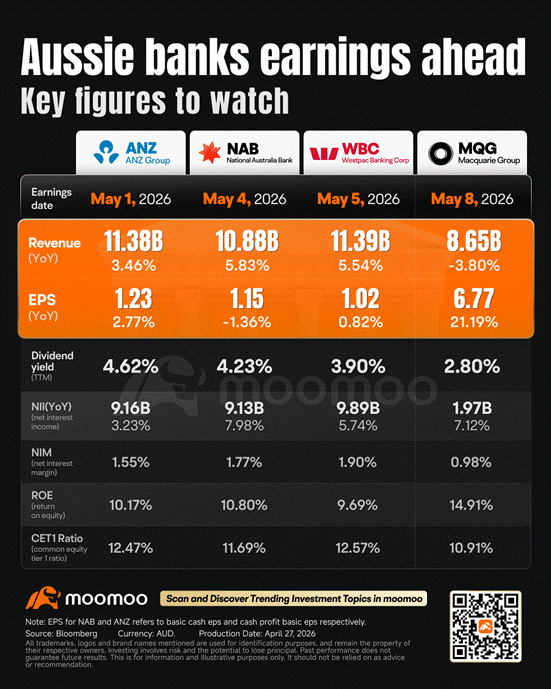
The following table summarises Bloomberg consensus estimates for the four banks reporting next month.
The Macro Backdrop
The Reserve Bank of Australia cut the cash rate three times in 2025, bringing it down by 75 basis points to 3.60%. That cycle has since reversed — two consecutive hikes in February and March 2026 lifted the rate to 4.10%, driven by inflation re-accelerating to 3.8% in January 2026, according to ABS monthly CPI data, and resilient consumer spending.
Adding to the uncertainty, the conflict in the Middle East has disrupted energy markets. Westpac flagged this directly in its April pre-announcement, noting that the energy supply shock is expected to result in higher inflation and interest rates, and that it has added a new provision overlay for energy-intensive sectors.
According to Roy Morgan data from February 2026, approximately 24.9% of mortgage holders (around 1.32 million) were considered “At Risk” of mortgage stress, with modelling suggesting this could rise to roughly 28.8% following the rate hikes.
Five Things to Watch
1. Net Interest Margins
CBA’s half-year results (for the period ending December 2025) showed a NIM of 2.04%, down 4 basis points, driven primarily by home lending competition and lower Treasury and Markets income. Westpac’s pre-announcement indicated core NIM was stable in the second quarter, but Treasury and Markets NIM dropped sharply — to 7 basis points from 15 basis points in Q1 — due to interest rate volatility.
NAB’s Q1 trading update reported a 12% rise in underlying profit versus 2H25 but did not disclose a specific NIM figure. Bloomberg consensus estimates point to half-year NIMs of 1.90% for Westpac, 1.77% for NAB and 1.55% for ANZ — all below the 2.04% CBA reported in its half-year results to December 2025, suggesting margin pressure remains a sector-wide theme.
The RBA noted in its February 2026 bulletin that the narrowing in mortgage rate spreads reflects both cyclical and structural factors — suggesting competitive pressure on margins may persist even as rates rise.
2. Credit Quality
In the previous reporting season, loan loss ratios averaged approximately 5 basis points across the majors, according to Morgan Stanley — well below the historical average of around 7 basis points. ANZ’s Q1 update also pointed to improving credit quality, with provision charges remaining contained.
However, Westpac’s pre-announcement introduced a new portfolio overlay for energy-intensive sectors, pushing its collective allowance ratio to approximately 129 basis points of credit risk-weighted assets, with a credit impairment charge of 10 basis points of average gross loans. Morgan Stanley has flagged that a sharper economic slowdown in H2 2026 could bring credit quality back into focus.
3. Capital and Dividends
CET1 ratios remain well above the “unquestionably strong” threshold of 10.5% set by the Australian Prudential Regulation Authority (APRA). Bloomberg consensus estimates CET1 at 12.57% for Westpac, 12.47% for ANZ, 11.69% for NAB and 10.91% for Macquarie. CBA reported 12.2% in its half-year results to December 2025. Following the previous results, Macquarie Research removed dividend cut assumptions for all four banks.
Separately, NAB has announced an A$1.8 billion underwritten DRP equity raising and increased loan provisioning — a development that weighed on its share price in late April.
4. Cost Discipline
Efficiency is emerging as a key differentiator. Westpac’s April pre-announcement indicated its ongoing UNITE transformation programme delivered a 2% decline in half-year expenses. Earlier, ANZ’s Q1 trading update (to December 2025) showed an 8% reduction in underlying operating expenses — a major driver behind its 17% profit increase and the improvement in its cost-to-income ratio to below 50%.
5. Valuations and Analyst Views
Valuations vary significantly across the sector. CBA trades at a forward P/E of approximately 26.2x, according to moomoo data — a notable premium over its Big Four peers. ANZ, WBC and NAB trade in a forward P/E range of roughly 14–18x. According to Morgans (April 2026), both ANZ and NAB carry sell ratings, with price targets of A$30.72 and A$34.56 respectively. Morningstar has described the earnings growth outlook as “soft,” forecasting approximately 5% net interest income growth per annum through to fiscal 2030.
Individual Bank Snapshots
ANZ (May 1)
Since Q1, ANZ has accelerated its ANZ 2030 strategy — launching a cultural reset under CEO Nuno Matos, advancing the A$4.9 billion Suncorp Bank integration (targeting A$260 million in annual synergies by 2027), and progressing a workforce reduction of approximately 4,500 roles with a A$560 million restructuring charge. APRA’s court-enforceable undertaking and A$1 billion capital add-on for non-financial risk management remain an overhang. Key focus: sustainability of Q1’s 8% expense reduction, Suncorp synergy milestones, and the A$150 million regulatory remediation cost burden.
NAB (May 4)
NAB’s April 20 disclosure was the quarter’s most significant: A$706 million in credit impairment charges (doubled year on year), including a A$300 million forward-looking provision increase for energy-intensive sectors such as agriculture, transport and manufacturing. A A$1.35 billion software write-down from a capitalisation policy overhaul will weigh on reported NPAT. To rebuild capital, NAB announced a A$1.8 billion underwritten DRP to lift CET1 above 12%. New CFO Inder Singh (ex-QBE) started in March. Key focus: whether provisions stabilise in 2H, NIM trajectory, and dividend sustainability after DRP dilution.
Westpac (May 5)
Westpac’s April 14 pre-announcement offered the most detailed pre-results read-through: core NIM held at 1.79% in Q2, but Treasury NIM halved to 7 basis points on rate volatility. Expenses fell 2% as the UNITE programme progresses — 44% through its simplification phase, with 8 of 57 initiatives complete. A new energy-sector provision overlay pushed credit impairment to 10 basis points. The RAMS portfolio sale to a Pepper Money / KKR / PIMCO consortium remains on track for H2, with a A$75 million NPAT hit in 1H26. Separately, new CFO Nathan Goonan has engaged Bain & Company to identify further efficiencies. Key focus: NIM composition (core vs Treasury), UNITE milestone delivery, and whether the energy overlay needs further expansion.
Macquarie (May 8)
Unlike the Big Four, Macquarie enters results as a potential beneficiary of macro turbulence — Morgan Stanley flagged MQG as likely to profit from “wild swings in commodity prices” via its CGM division. The private credit portfolio has grown to A$28.9 billion, deploying A$5.7 billion in Q3 alone. A landmark ~US$40 billion sale of Aligned Data Centers to a BlackRock / Nvidia / Microsoft-backed consortium is expected to close in H1 2026, potentially generating significant performance fees. Key focus: CGM commodity trading income (the key swing factor), Aligned deal timing and associated fees, and full-year dividend.
Join the discussion. See what’s trending right now on Australia’s largest stock forum and be part of the conversations that move the markets.
The material provided in this article is for information only and should not be treated as investment advice. Viewers are encouraged to conduct their own research and consult with a certified financial advisor before making any investment decisions. For full disclaimer information, please click here.