
Join our daily newsletter At The Bell to receive exclusive market insights
- Australia’s home value index is up 3 per cent on the previous year, as buyers choose low-density houses in the country over high-density apartments in cities
- Regional Australia has outperformed the capital cities in terms of dwelling value growth for the year
- A combination of monetary and fiscal measures such as the federal government’s HomeBuilder grant and low-interest rates can be owed to the market’s rebound, according to CoreLogic
- While the report maintains an overall positive sentiment, it heeds investors should be wary, as COVID-19 still presents potential short-term risks to property markets as waves of outbreaks appear and rescind
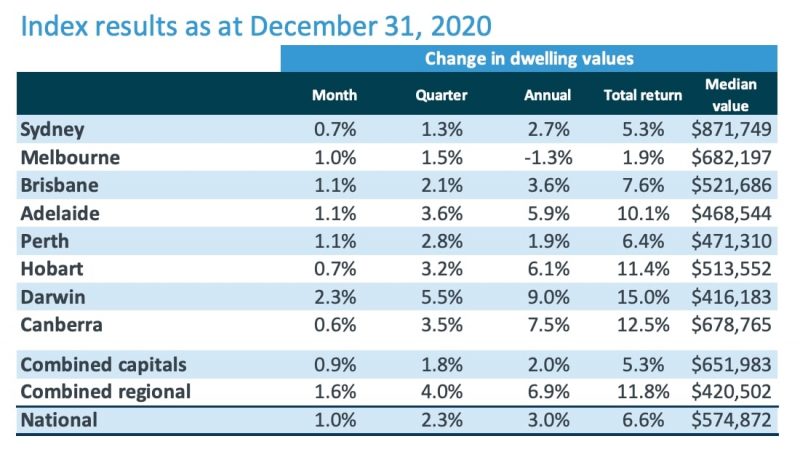
Australia’s home value index is up 3 per cent on the previous year as buyers choose low-density houses in the country over high-density apartments in cities.
A housing market report from CoreLogic revealed the median value for regional properties is up 6.9 per cent compared to 2020 figures, a stark contrast to a modest 0.2 per cent increase in capital city unit values.
The report implies a positive start to 2021, as the national home value index rose one per cent for December, representing a third consecutive month of growth.
Described by Corelogic’s research director as “unprecedented volatility in the transaction space”, buyer volumes surged towards the tail end of 2020 as a combination of lockdowns and government stimulus packages inspired a new wave of homeowners.
The year ended with house sales up 8 per cent on the previous year, marking an impressive turnaround for an industry that saw property sales plummet 40 per only months prior.
Source: CoreLogic
Escape to the country
With the exception of Western Australia and Northern Territory, regional Australia outperformed the capitals in terms of dwelling value growth.
Tasmania leads the charge with an 11.9 per cent increase, followed by an 8.3 per cent jump in New South Wales.
The report attributes the surge to a prevalence of remote working opportunities and a demand for lifestyle properties and lower density housing.
“Regional housing markets had generally underperformed relative to the capital city regions over the past decade, but 2020 saw regional housing values surge as demand outweighed supply,” CoreLogic research director Tim Lawless explains in the report.
Conversely, higher density housing has underperformed throughout the year.
“Unit markets have historically been more popular amongst investor buyers;
demand from investors has been weighed down by weak rental conditions across the unit sector along with high supply levels in some precincts,” Tim commented.
Stimulus measures
A combination of monetary and fiscal measures, such as the federal government’s HomeBuilder grant, and low interest rates can be owed to the market’s rebound, according to CoreLogic.
The report describes the activity as retrospectively “unsurprising”.
“Record low-interest rates played a key role in supporting housing market activity, along with a spectacular rise in consumer confidence as COVID-related restrictions were lifted and forecasts for economic conditions turned out to be
overly pessimistic,” Tim said.
The year ahead
While the report maintains an overall positive sentiment, it heeds investors should be wary, as COVID-19 still presents potential short-term risks to property markets as waves of outbreaks appear and rescind.
“As demonstrated by Melbourne’s second round of lockdowns, new restrictions associated with a COVID outbreak would set back the economic recovery and have a negative, although temporary, impact on housing markets,” the report reads.
“Although the trajectory for housing markets is looking positive as we move into 2021, the downside risks remain clear and present,” it concludes.
The CoreLogic Hedonic Home Value Index is calculated using recent sales data combined with attributes of individual properties such as the number of bedrooms and bathrooms, land area and geographical context.