
Join our daily newsletter At The Bell to receive exclusive market insights
- Like many companies, iron ore giant BHP (BHP) has been hit by the COVID-19 slump, but the miner has proven the days in the red aren’t to last, with the stock surging upwards in the last three months
- While shares lost 0.42 per cent before the weekend, the BHP stock is ultimately on the rise, bolstered by resilient iron ore pricing
- The future, currently priced at around $100/tonne, has been stabilised by supply constraints in Brazil, coupled with surprisingly resilient demand in China
- Iron ore’s current performance is good news for BHP, which reported a record iron-ore output of 248 million tonnes in WA over the last quarter
- However, the miner has forecast lower copper, metallurgical coal and petroleum production in FY21, thanks to COVID-19 restraints
- While the current outlook is a little muddy, clearer projections could be on the horizon as international supply constraints are resolved, demand begins to rise, and economies begin to recover
- BHP shares ended the day trading for $37.10 per share in a $109.7 billion market cap
Like many companies, iron ore giant BHP (BHP) has been hit by the COVID-19 slump. But the miner has proven the days in the red aren’t to last, with the stock surging upwards in the last three months.
Now, BHP has almost recovered this year’s losses. So will steady iron ore futures be enough to boost shares into the green? Or will softened copper, petroleum and metallurgical coal production forecasts keep the gains at bay?
Large and small-caps alike were unable to escape the red when COVID-19 began to grip international markets in the first half of the year.
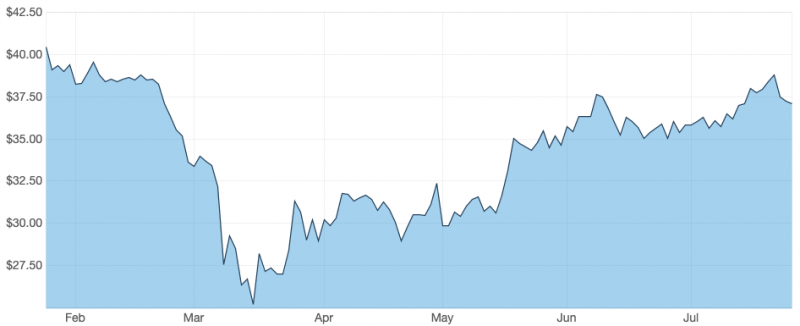
Between mid-February and mid-March came the worst of the sell-offs, where BHP shares shed roughly $15 — taking shares almost 40 per cent lower than their $41 2020 high.
Source: Market Index
Since the dip, however, BHP stock has begun to climb once more. Now, shares are worth just over $37 dollars, just $4 dollars away from this year’s peak.
While shares lost 0.42 per cent before the weekend, BHP stock is ultimately on the rise, bolstered by resilient iron ore pricing.
A steady market
Interestingly, iron ore pricing has held fast during the COVID-19 pandemic. The latest quarterly from the Department of Industry, Science, Energy and Resources says the future has been stabilised by supply constraints in Brazil, coupled with surprisingly resilient demand in China. The result? Solid forecasts for our homegrown export markets.
“Australia’s iron ore export values are estimated to have risen from $78
billion in 2018–19 to $103 billion in 2019–20, on the back of growing volumes, strong prices and a low Australian dollar,” the report explained.
However, while analysts maintain the good fortune is here to stay for the rest of 2020, the pandemic could grip markets down the track.
“Prices are likely to come under downward pressure after 2020, as supply shifts back towards normal levels. However, a significant global recovery is also expected in 2021, which will likely add to steel demand and provide a floor for prices,” the report continued.
“The weak demand and poor supply that appear likely to characterise 2020 are thus expected to go into reverse in 2021,” it concluded.
So far, iron ore has defied market expectations and stayed above US$100 (around A$141.21) a tonne.
BHP’s production outlook
Iron ore’s current performance is good news for BHP, which reported a record iron-ore output of 248 million tonnes in WA over the last quarter.
“We continue to believe that if China can avoid the second wave of COVID-19, steel and pig iron production can both rise in the 2020 calendar year versus the prior year,” BHP wrote on in its June quarterly update on Monday.
However, the miner has forecast lower copper production in FY21 — down to between 1480 and 1645 kilotonnes compared to FY20’s 1724 kilotonnes.
In addition, the ASX-200 lister reported slightly lower production outlooks across its petroleum and metallurgical coal divisions for the new financial year. For the most part, BHP has chalked the lower-than-expected forecasts up to COVID-19-related setbacks.
Speaking to the projections, Lyndon Fagan, JPMorgan’s mining and metals analyst, said “some softness was expected in copper … however, petroleum and met coal are also slightly lower than we expected.”
BHP will release its full FY20 report on August 18.
What’s in store?
Moving into the new financial year, what do analysts say about the iron ore giant’s performance?
Today, Morningstar issued a neutral rating for BHP, giving the stock a $40 12-month price target. It’s not too far for BHP to go if it continues the last few months of gains.
In addition, out of a panel of five analysts, the recommendation is fairly mixed. One says BHP is a strong buy, one is moderate, two recommend that investors hold and the last advise the stock is a moderate sell.
While the current outlook is a little muddy, clearer projections could be on the horizon as international supply constraints are resolved, demand begins to rise, and economies begin to recover.
BHP shares ended the day trading for $37.10 per share in a $109.7 billion market cap.