
Join our daily newsletter At The Bell to receive exclusive market insights
- The Australian Government has joined the United States in openly rejecting China’s bold claims to territory and resources in the South China Sea
- U.S. Secretary of States rejected China’s claims to most of the area as “unlawful” and slammed its use of “bullying” to control the South China Sea
- Last week, Australia wrote a letter to the United Nations echoing the States,’ saying there is no legal basis for China’s claims to the area
- This comes as Australia-China relations continue to sour over a range of issues from trade tensions to the origins of COVID-19
- China’s Global Times released a scathing criticism of Australia’s decision to chime in on the South China Sea disputes
- In the article, China threatened to retaliate by targeting agricultural products like beef and wine if Australia keeps siding with the United States
The Australian Government has joined the United States in openly rejecting China’s bold claims to territory and resources in the South China Sea.
Earlier this month, United States Secretary of State Mike Pompeo slammed China’s “unlawful” claims to offshore resources across most of the South China Sea and what he called a “campaign of bullying” to control the area.
“The world will not allow Beijing to treat the South China Sea as its maritime empire,” Secretary Pompeo said.
Last week, Australia wrote a letter to the United Nations in which it echoed the U.S. and rejected China’s claims to the South China Sea Area.
The Australian Government said China’s claims are inconsistent with international law, citing the 1982 United Nations Convention of the Law of the Sea (UNCLOS).
“There is no legal basis for China to draw straight baselines connecting the outermost points of maritime features or ‘island groups’ in the South China Sea, including around the ‘Four Sha’ or ‘continental’ or ‘outlying’ archipelagos,” the government letter said.
“Australia rejects any claims to internal waters, territorial sea, exclusive economic zone and continental shelf based on such straight baselines.”
The Australian Government, July 2020
What’s the dispute?
Ownership of the South China Sea area has been in dispute by surrounding countries for years, with the likes of China, the Philippines, Taiwan, and Malaysia each claiming ownership of certain parts of the area.
Beijing’s claim is by far the biggest, however, declaring ownership of a two-million-square-mile area outlined by what China calls the “nine-dash line”.
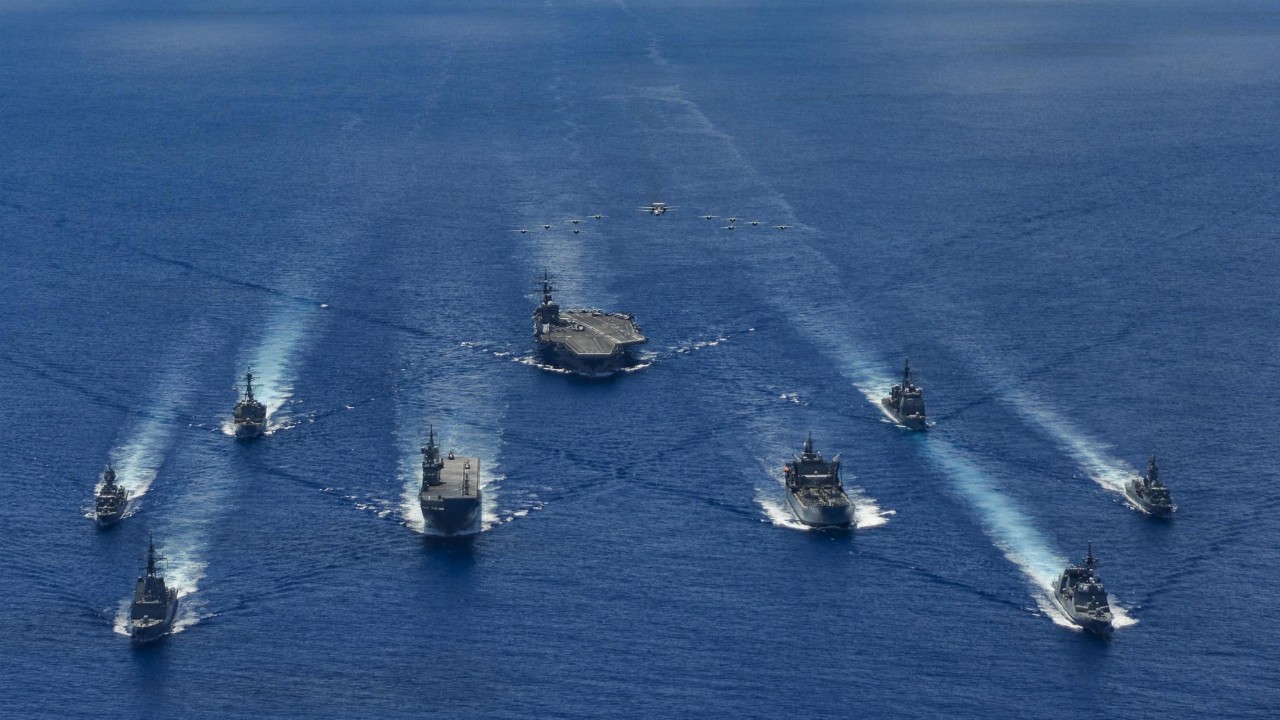
Tensions over the South China Sea have been escalating in recent years as China builds military bases on natural and artificial islands in the area. Australia addressed this in its U.N. letter, saying China’s actions do not give it any more legal claim to the islands and resource-rich seas.
“Land building activities or other forms of artificial transformation cannot change the classification of a feature under UNCLOS,” the letter said.
“There is no legal basis for a maritime feature to generate maritime entitlements beyond those generated under UNCLOS by that feature in its natural state,” it explained.
China’s response
Australia’s rejection of China’s claims comes as relations between the two countries continue to sour over a range of issues from Australia’s call to investigate the origins of the COVID-19 coronavirus to China’s recently-introduced barley tariffs to Hong Kong trade.
Over the weekend, China’s Global Times — a newspaper speaking on behalf of the Chinese government — released a scathing criticism of Australia’s decision to chime in on the South China Sea dispute.
“Although China-Australia relations have already drastically soured, Australia has chosen to show its loyalty for the US. It rejected China’s claim at the UN level, which will have quite a negative impact,” it said.
The article came with some vague threats to Australia.
“The relationship between China and Australia has now deteriorated to a very bad point, and the chance for a turnaround is slim in the near future,” the paper said.
“If Australia further provokes China, not only on political relations but also economic relations, the damage to Australia should be expected,” it said.
“If [Australia] still insists on going on the current path, the possibility that China will take strong countermeasures cannot be ruled out,” the article concluded.
China said Australian agricultural products like beef and wine could come under fire if Australia keeps provoking Beijing.