
Join our daily newsletter At The Bell to receive exclusive market insights
- Chinese and French foreign ministries discredit the AUKUS deal, accusing the allies of being secretive while damaging stability and peace.
- US Defence Secretary Lloyd Austin says factors include higher terrorism risks and climate change dangers
- The Chinese Foreign Ministry accuses AUKUS of aiding an arms race and ignoring nuclear non-proliferation efforts
- French Foreign Minister Jean-Yves Le Drian calls the agreement “brutal and unpredictable”
Chinese and French foreign ministries have discredited the AUKUS deal, accusing the allies of being secretive while damaging stability and peace.
European Union’s Foreign Policy Chief Josep Borrell said he was kept in the dark about the deal, adding that a partnership of this nature could not have been established overnight.
“Despite that [announcement happening overnight], no we were not consulted,” Mr Borrell said.
Criticism from China
The Chinese Foreign Ministry accused the three countries of aiding an arms race and ignoring nuclear non-proliferation efforts.
“[AUKUS is] severely damaging regional peace and stability, intensifying an arms race and damaging international nuclear non-proliferation efforts,” Chinese Foreign Ministry spokesperson Zhao Lijian said.
The backlash from China is incongruent with the nation’s own investments in nuclear energy and military spending.
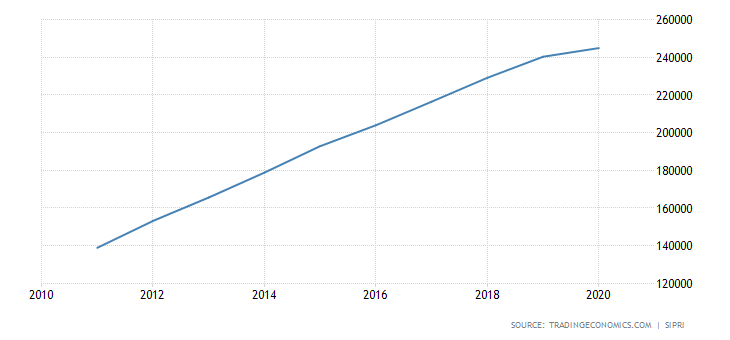
Chinese military expenditure data from Trading Economics showed an increase of almost two per cent, or $6.3 million, between 2019 and 2020.
According to the International Insitute for Strategic Studies, China places third on the list with six nuclear submarines, following Russia with 11 nuclear submarines and the US with 14.
In a conference, US Defence Secretary Lloyd Austin hinted the partnership was a consequence of China’s part in militarising Indo-Pacific waters. In addition, reports have shown strong relationships between with North Korea, China and Russia.
The Council on Foreign Affairs, an independent think tank, said China was forced to defend North Korea from military aggression under the ‘1961 Sino-North Korean Treaty of Friendship, Cooperation, and Mutual Assistance’, which is up for renewal this year.
Hence China has previously requested world powers to not push North Korea too much for fear of triggering the leadership’s collapse and military action.
Mr Austin said other factors included higher terrorism and climate change risks.
“We spoke in detail about China’s destabilising activities in Beijing’s efforts to coerce and intimidate other countries, contrary to establishing rules and norms,” Mr Austin said.
French Frustration
French Foreign Minister Jean-Yves Le Drian called the agreement “brutal, unilateral and unpredictable”. He even likened the nature US President Biden’s decision on AUKUS to those of his predecessor, President Donald Trump.
The AUKUS deal directly implicated the French Naval Group which lost a $90 billion deal with Australia to build a fleet of French-designed submarines.
“We built a relationship of trust with Australia and this trust was betrayed. And I am angry today with a lot of bitterness about this breach [of contract],” Mr Drian said.
He said France’s anger came from the “stab in the back” from Australia, an ally with which they had been in discussions for more than two years.
AUKUS defence
Australia continues to feel the pain of trade withdrawals from China after a statement released by the Communist country said it was intentionally trying to control the prices of Australian imports, among other more political moves.
However with trade declining and threats increasing, Australia have formed a new pact with its traditional allies.
UK Defence Secretary Ben Wallace said: “[China was] embarking on one of the biggest military spends in history … Our partners in those regions want to be able to stand their own ground.”
Meanwhile former Australian prime minister Tony Abbott has entered the debate, expressing concerns that the size of the Chinese military far exceeds that of the US.
“I don’t think people have quite worked out yet, just how massive the Chinese military machine has become,” Mr Abbott said. “In sheer numbers, the Chinese fleet is now much larger than the US fleet in terms of missiles.”