-1280x720.jpg)
-1280x720.jpg?v=1)

Join our daily newsletter At The Bell to receive exclusive market insights
- A bump in fuel prices has driven the latest round of inflation, as the consumer price index (CPI) rises three per cent over the year
- Trimmed mean inflation, the Reserve Bank of Australia’s preferred measure of inflation, rose to 2.1 per cent in the third quarter, up from 1.6 per cent in the previous quarter
- The most substantial price increases in the September quarter were new residences (+3.3 per cent) and fuel (+7.1 per cent)
- The June quarter wage index from the ABS shows that wages are not keeping up with inflation, with wages growing by 1.7 per cent over the year to June 2021
- Fruit prices fell the greatest (-8.3 per cent) due to favourable growing conditions and clothing prices declined (-5.5 per cent)
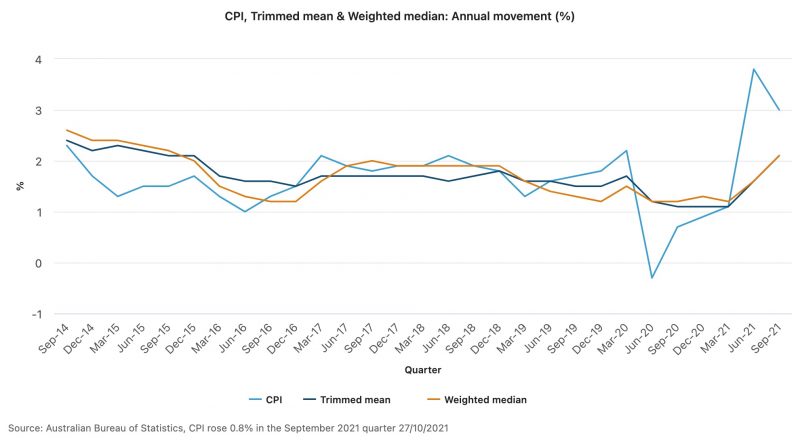
A bump in fuel prices has driven the latest round of inflation, as the consumer price index (CPI) rises three per cent over the year – with underlying inflation breaking the two per cent ceiling.
The CPI rose 0.8 per cent in the September 2021 quarter, according to the latest data from the Australian Bureau of Statistics (ABS).
The impact of irregular or transitory price changes in the CPI, such as the big fuel price rises this quarter or the impact of free childcare in 2020, is mitigated by underlying inflation measures.
These indicators have increased at the fastest yearly rate since 2015.
Trimmed mean inflation, the Reserve Bank of Australia’s preferred measure of inflation, rose to 2.1 per cent in the third quarter, up from 1.6 per cent in the previous quarter.
RBA governor Philip Lowe has previously stated that inflation must be over two per cent in order for the bank to be persuaded of ongoing price pressures that might contribute to interest rate increases. The interest rate is currently at a historic low of 0.1 per cent.
ABS head of prices statistics Michelle Marquardt stated that the most substantial price increases in the September quarter were new residences (+3.3 per cent) and fuel (+7.1 per cent).
“Construction input costs such as timber increased due to supply disruptions and shortages,” Ms Marquardt said. “Combined with high levels of building activity, this saw price increases passed through to consumers.”
“Rising fuel prices also contributed to the September quarter CPI increase, with the CPI’s automotive fuel series reaching the highest level in its half-century history.”
A key driver of the CPI increase is the massive increase to fuel prices, which have risen 36 per cent from the lows seen in mid-2020.
The June quarter wage index from the ABS shows that wages are not keeping up with inflation.
The annual wage growth to the end of the June quarter was just 1.7 per cent.
Rents increased (+0.2 per cent), with increases in most cities offset in part by reductions in Sydney and Melbourne.
Due to global supply interruptions, prices for various commodities increased, including furniture (+3.8 per cent), motor cars (+1.4 per cent), and audio-visual equipment (+1.8 per cent).
Fruit prices fell the greatest (-8.3 per cent) due to favourable growing conditions for berries, avocados, and citrus fruits, as well as lower demand from the food service industry due to lockouts in Sydney and Melbourne.
Clothing prices declined (-5.5 per cent) as businesses sought to shift extra winter stock as sales plummeted due to lockdowns, according to retail trade statistics.