

Join our daily newsletter At The Bell to receive exclusive market insights
For regular ASX market-watchers – particularly those interested in listed junior explorers – a gold project based around or located near historical workings is a fairly regular occurrence.
After all, Australia has been home to numerous gold rushes through its history. That’s true for the eastern states but it’s perhaps most prominently felt in Western Australia where the town of Kalgoorlie stands as a testament to what gold deposits mean for local economies.
The general calculus around the potential benefits of adopting a parcel with historical mining on-site is obvious. Existing open pits still present mean less capex for companies insofar as project economics go, assuming no surprises when it comes to geotech or dewatering.
Similarly, existing underground mines can be hugely beneficial if the company’s able to economically exploit them, given the price of underground mining tends to skyrocket vertically once builders get beyond the portal.
Only one part of the story
But finding gold and digging the ground for it is only one part of the story.
While gold may make the uninitiated think of gold nuggets, for many mining projects around the world, the crushed fines that actually get turned into gold don’t shine or sparkle. It’s only through assays one knows they contain gold at all.
And to turn those fines into gold bars, they need to go through a lot of processing.
And it’s this stage of gold mining that stops many junior explorers in their tracks – they’re required to bring on partners, diluting their stake in the value of the landholding; or otherwise operators are forced to send away product long distances to be processed and returned by a second or third party elsewhere.
So for a junior explorer to have its own gold processing capacity is highly desirable assuming a robust project economic profile, for it enables the transition from explorer to developer to run far smoother.
Enter WIN Metals (ASX: WIN)
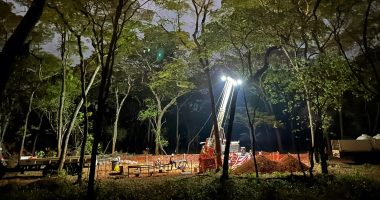
WIN Metals’ (ASX: WIN) is the owner and operator of its WA-based Radio gold project, located Northwest of Southern Cross – the town that gave birth to WA’s eastern Goldfields.
WIN’s Radio project is one example of an exploration company sitting on top of both a gold deposit, and, uniquely a project already equipped with the bulk of the equipment and infrastructure necessary to mine and process it.
It’s also a project that’s returned bonanza gold grades during its earlier life – perhaps unsurprising, given the project straddles favourable greenstone geology.
With that feather already in its cap, WIN Metals recently acquired a purchase option over a 120,000tpagravity processing circuit which, when combined with a modest leach circuit will ultimately be fed feedstock from an existing underground mine and new open pit mine on-site Radio for a targeted initial 20,000 ounces of gold over the life of the project.
And that 120,000tpa facility is seen as a first-stage project profile in the eyes of WIN Metals’ Managing Director Steve Norregard.
“The project was acquired with the concrete foundations already 80% complete for a much larger plant,” Norregaard told HotCopper.
“We have used this footprint with some minor modifications to make it suitable for our right sized facility … this in addition to securing an option over the gravity plant has anchored our plans at a very cost effective entry point.”
Those cost metrics were recently laid-out in a project Re-start Study commissioned by WIN Metals to address the plans and costings of re-starting Radio.
Versatile asset: from lithium to gold
WIN Metals entered into an agreement with ASX-listed Tungsten Mining NL (ASX:TGN) in June of this year to acquire the latter’s 120Ktpa modular gravity processing plant which was at one point designed to pull tantalite from pegmatite ore.
Notably, the plant only ever ran for one month back in 2014 before it was effectively mothballed, which means that while WIN is looking at some maintenance here and there, the processing plant hasn’t sustainedany substantial wear– removing uncertainty from the Radio re-start.
“The gravity plant … combined with a newly constructed CIP circuit will see of an estimated $8m total cost, a cost that makes it feasible to consider on such a modest initial resource base” Norregard said.
“Given we are opting for contract crushing and as part of the acquisition of the gravity plant virtually all electrical equipment required for the entire build are included, so we are well insulated against many of the areas of cost escalation seen in a complete new plant.”
The modular gravity plant’s re-commissioning is a key aspect of the processing facility given the Radio ore exhibits very high gravity recovery of up to 75%-80% ,Highly desirable for the company, as revenue will be realised virtually immediately after ore is processed aiding cash flow
The plant comes equipped with a Run Of Mine (ROM) Bin and conveyor belts; a rotary scrubber and ball mill to reduce the crushed ore size to minus 106 micron then screening to remove gangue material then gravity separation and thickening
Once feedstock is run through these steps, the remaining gold is extracted via newly constructed Carbon-In-Pulp (CIP) cyanide leaching circuit.
“With the very high gravity recovery expected – we intend pouring gold bars onsite from the gravity concentrate but the gold won from leaching will be stored on activated carbon until gold loading is high enough then pulled out of the CIP circuit and trucked to Perth or Kalgoorlie for custom stripping leading to anoverall recovery of 95%. ” Norregaard explained.
When queried on the risk of cost blowouts, Norregaard remains confident capex can be kept under control – outside of the currently-volatile fuel price dynamics borne from the ongoing conflict in the Middle East.
“We haven’t seen any major issues with respect to cost surprises other than the wild swings in diesel price , during the study our ex diesel fuel rebate price has moved in excess of 50%,” Norregaard elaborated.
“We have used a conservative number reflecting the higher price to ensure no surprises in the execution phase … sulphuric acid prices are also sky high at the moment given supply issues with the US/Iran conflict [that’s] a problem for the laterite nickel miners and the lithium miners, but not so much gold miners.”