
Join our daily newsletter At The Bell to receive exclusive market insights
- The Health Services Laboratories (HSL) Halo lab is one of the most prestigious medical research facilities across the globe
- The building staffs 1000 people over 100,000 square feet of laboratories in the wider MedCity health sciences hub in London
- ASX-listed LBT Innovations recently installed its Automatic Plate Assessment System (APAS) device in the Halo building
- What’s more, the company had the tech installed completely remotely
- Not only is this a major endorsement of LBT’s APAS device, but it’s evidence of the company’s disruptive and adaptive strategy for a post-COVID-19 era
Across the world, there are a handful of medical research labs that outclass all others in their field.
One of these such facilities is the Health Services Laboratories (HSL) Halo building in the United Kingdom.
HSL is a partnership between Royal Free London NHS Foundation Trust, the University College London Hospitals NHS Foundation Trust, and The Doctors Laboratory — a subsidiary of ASX-listed radiology and pathology giant Sonic Healthcare (SHL).
The HSL partnership is renowned for the quality of its resources, with only the best equipment, the smoothest systems, and the brightest minds being used across its lab suite.
In fact, Dr Vanya Gant, UCLH’s Divisional Clinical Director for Infection, said he has never seen a facility like HSL’s in over three decades.
“In over 30 years of working as a physician in the National Health Service I have never, ever, ever seen such investment and energy and optimism and focus on moving to the next generation of what can be done with diagnostic medicine.”
Dr Vanya Gant, UCLH Divisional Clinical Director for Infection, September 2016
However, Sonic is not the only ASX-listed medical stock exposed to this cutting-edge facility.
LBT Innovations (LBT) installed its Automatic Plate Assessment System (APAS) device in HSL’s world-class Halo laboratory in July 2020.
The Halo lab is the flagship lab of the HSL building; the U.K.’s heart of pathology and diagnostic research. The facility is home to more than 100,000 square feet of laboratories and staffs 1000 people.
The building is part of the wider MedCity health sciences hub in London, which was created in 2014 as a way to connect the U.K.’s leading medical research organisations.
Why LBT?
So, if the Halo facility is so prestigious, why install the tech of a small-cap Australian company?
It all comes down to the potential of the APAS device to streamline key areas of microbiology.
Essentially, LBT’s APAS tech uses artificial intelligence to automatically read and categorise culture plates. Ordinarily, microbiologists need to scour through hundreds of plates to find significant bacterial colonies which they can then study to discover what causes different diseases and illnesses in the body.
The APAS device does this automatically, with impressive accuracy, and at least three times quicker than the average microbiologist.
In July, HSL’s Head of Department, Infection Sciences, Alan Spratt said the organisation was excited to be conducting the first U.K. trial of the APAS machine.
“The application of assisted intelligence in a high-volume lab like ours has the potential to streamline laboratory workflows bringing benefits to staff, quality, turnaround times and consequentially patient outcomes,” Alan said.
This is a massive vote of confidence for the APAS device.
For LBT, this is all part of the company’s strategy of getting its tech into the hands of the best researchers and laboratories. Importantly, LBT was able to execute this strategy despite the challenges presented by the COVID-19 pandemic.
Disruptive adaptation
With international borders sealed shut across the globe, July 2020 was an unusual time for a company to install its tech in an overseas lab.
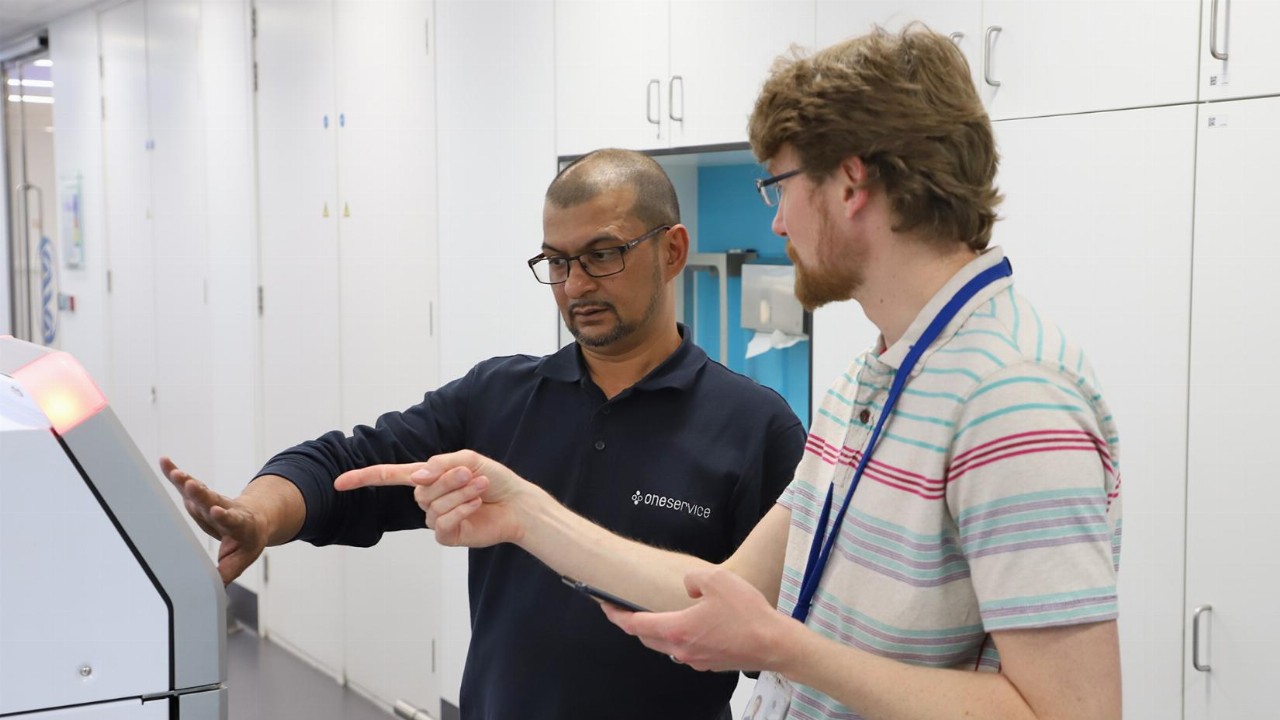
However, LBT was able to get the job done 100 per cent remotely with the help of its recently-appointed service provider, oneservice.
The LBT team worked closely — via Zoom — with the HSL and oneservice teams to install the APAS tech in just two days.
This proves two things for LBT: firstly, the company’s tech is so intuitive and easy to install that it does not need weeks of planning and careful navigation but rather just days and remote management oversight to get it up and running. Secondly, the company is flexible enough to achieve its goals in the midst of challenges instead of waiting for the waters to calm down.
While all eyes are on digital and non-contact healthcare in light of COVID-19, LBT has started to disrupt a different sector of the health and wellness world: tech installation.
With the world’s first non-contact diagnostics installation going off without a hitch, the possibilities unlocked by LBT are endless.
The coronavirus might be keeping people indoors, but LBT has proven that the transition to online and at-home work has left myriad sectors primed for disruption.
While the APAS device is enough to write home about on its own, the company’s strategy execution is laying down the foundations for LBT to make the most of the post-COVID world.