

Author: Dr Ryan D. Long
In our previous article on Mink Ventures Corporation’s (TSXV:MINK), published three months ago, we discussed how the new reinterpretation of the Warren Nickel-Copper-Cobalt Project’s geology could transform the company’s future if results from the H1 2026 drill programme supported the new geological model.


Listen to the HotCopper podcast for in-depth discussions and insights on all the biggest headlines from throughout the week. On Spotify, Apple, and more.
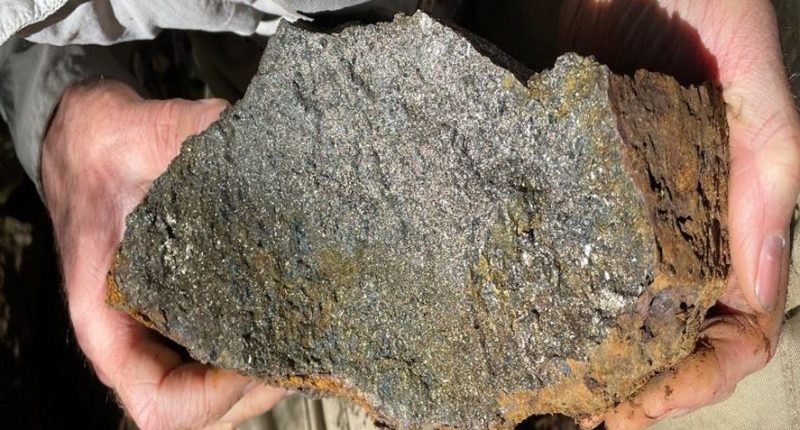
Well, the drill results are in, and they have resulted in the discovery of a large near-surface zone of nickel-copper-cobalt massive sulphide mineralisation in the A-Zone (Figure 1), supporting the potential for other larger magmatic sulphide zones across the property. Assay results include:
- 12.0 m @ 0.5% Ni Eq., or 0.29% Ni, 0.24% Cu and 0.04% Co from 6.0m (W-26-13)
- Including:
- 7.1 m @ 0.71% Ni Eq., or 0.44% Ni, 0.28% Cu and 0.06% Co, and
- 4.0 m @ 0.82% Ni Eq. or 0.58% Ni, 0.18% Cu and 0.08% Co
- 18.0 m @ 0.23% Ni Eq., or 0.10% Ni, 0.16% Cu and 0.02% Co from 3.0 m (W-26-14)
- 8.5 m @ 0.24% Ni Eq., or 0.09% Ni, 0.23% Cu and 0.01% Co from 2.5 m (W-26-10)
- 3.0 m @ 0.24% Ni Eq., or 0.08% Ni, 0.24% Cu and 0.01% Co from 3.0 m (W-26-15)
- 2.0 m @ 0.30% Ni Eq., or 0.15% Ni, 0.22% Cu and 0.01% Co from 26.0 m (W-26-15)
In addition, the one hole completed in the previously untested D-Zone returned 5.6 m @ 0.34% Ni Eq., or 0.23% Ni, 0.09% Cu and 0.03% Co from 61.9 m (W-26-17A).

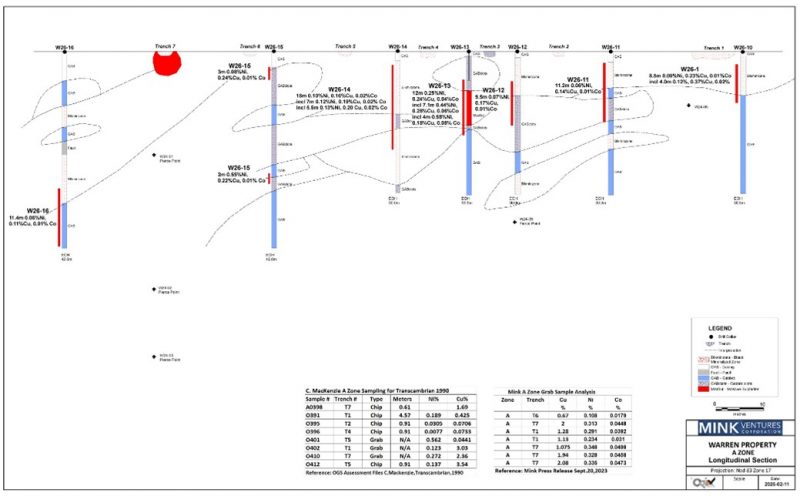
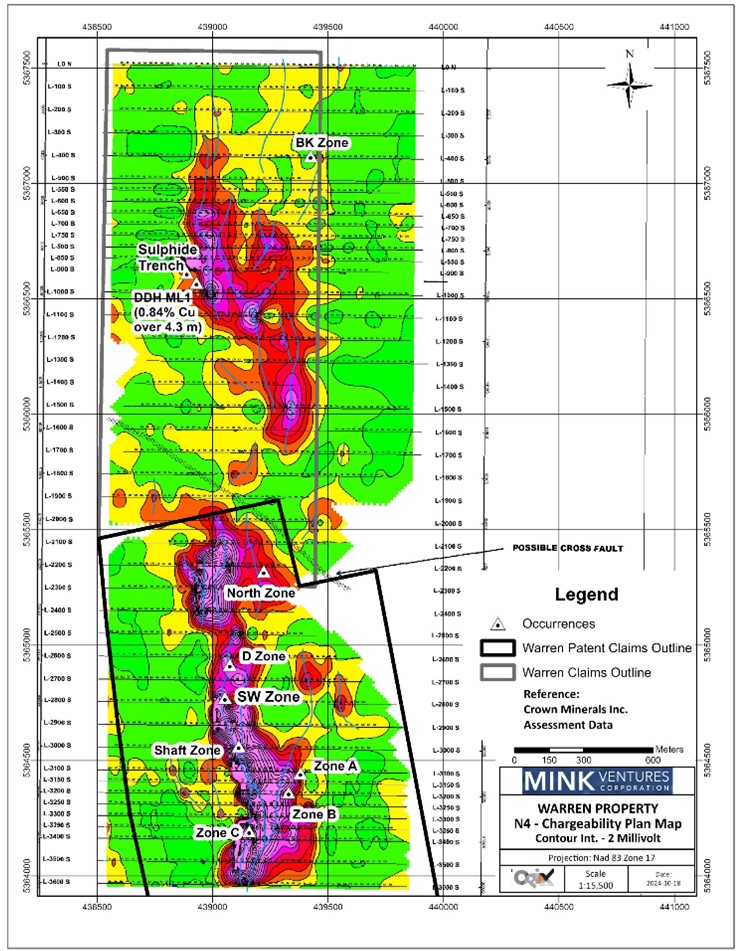
The near-surface intersections of nickel-copper-cobalt mineralisation cover a 120 m section of the A-Zone and are spatially associated with a mise-à-la-masse anomaly over a 500 m by 200 m area (Figure 2). The A zone anomaly is part of a larger geophysical targets that extend for 3 km (Figure 3).


Our Thoughts
Mink is really just starting to scratch the surface with its exploration programme at the Warren Project, and these results justify the commencement of a much larger drill programme.
The Company has already fully permitted its next drill programme, and this is expected to commence this summer. This programme will continue to test the A-Zone, the adjoining B-Zone, and around a newly developing mise-à-la-masse target (Figure 1) east of the A-Zone.
The North Zone (Figure 2) is also expected to be drill tested in the upcoming drill programme. This zone contains a 100-m diameter “bullseye” mise-à-la-masse response, and assays from grab samples returned 0.967% Ni and 0.07% Co in massive sulphide. Access to the North Zone was hampered in the recent campaign, and it therefore remains untested.
Mink also intends to purchase a historic VTEM survey, carried out across the property by previous operators, and have Maxwell plate analysis conducted to rank and prioritise the VTEM anomalies. Compilation work will prioritise the VTEM responses with known surface mineralisation and current ground geophysical data ahead of the upcoming drilling campaign.
The VTEM survey will also assist in prioritising potential copper-zinc volcanogenic massive sulphide (VMS) targets, located in felsic rocks along the western flank of the property, where a historic Morgain Minerals drill hole, ML-1, returned 0.84% Cu over 4.3 meters on the periphery of a large chargeability response with a strike length of 1.3 km (Figure 2).
Mink looks set to have a positive year ahead of it as it seeks to build on the momentum created by this drill programme.
Join the discussion. See what’s trending right now on Australia’s largest stock forum and be part of the conversations that move the markets.
The material provided in this article is for information only and should not be treated as investment advice. Viewers are encouraged to conduct their own research and consult with a certified financial advisor before making any investment decisions. For full disclaimer information, please click here.