



Join our daily newsletter At The Bell to receive exclusive market insights
When the US Federal Reserve chairman says “uncertainty remains unusually elevated”, investors should take notice. The reason is straightforward. Doubt can cause investors to freeze at exactly the wrong time. This is a real disadvantage, because in uncertain times, opportunity can be found.
Listen to the HotCopper podcast for in-depth discussions and insights on all the biggest headlines from throughout the week. On Spotify, Apple, and more.
While the future is always uncertain, the challenge now is that many of factors that fundamentally drive markets, and investors rely on, are themselves in question. These market threads are often interrelated and interdependent. And right now, they’re tied in one huge knot.
The way to untangle a knot is to pull the threads apart. And in this outlook, we’re disentangling the most important market influences and their potential impact – and considering them in a number of scenarios to help you think about your investments for this year.
1. Growth and inflation concerns in China, Europe and the US
Sustainable growth in an economy is one of the surest predictors of a rising sharemarket. One of the reasons for the outperformance of US markets over 2023 and 2024 was a better investable growth outlook.
The globe’s three major economies are positioned very differently as they enter the second half of 2025.
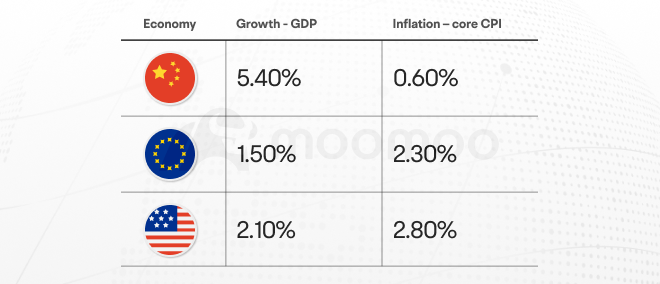
The data in the table above is the most recent year-on-year reading. It illustrates the different challenges each economy faces. Stimulus introduced in China in the final quarter of last year has boosted growth, but inflation data points to ongoing concern about demand.
In the US, growth is less impressive and inflation is still above target. However, the recent change of government saw some analysts revise growth estimates upward with expectation of a business-friendly agenda. But now many of those same analysts pulled their estimates lower (after the introduction of tariffs).
Europe has the weakest growth, but inflation is closer to target. (While Japan often gets the credit, Europe is the home of very significant amounts of investment capital.)
These three markets account for around two-thirds of the global economy. The International Monetary Fund’s best estimate for 2025 and 2026 is that the world economy will grow at 3.3% each year. This implies the world’s three major economies will broadly continue their current growth trajectory.
However, it’s relative performance that determines investment flows. The outperformance of the US sharemarket over 2023 and 2024 was largely driven by accelerating economic growth.
Similarly, despite a higher outright growth rate, the deceleration in the Chinese economy in the first half of 2024 contributed to underperformance in that market’s shares.

European economies have reacted cautiously to economic developments this year, and stock valuations are less stretched. It gives the appearance of a steady state. With China’s growth now heading into ‘too hot’ territory, and a populist US president likely to try anything to be re-elected, the overall flows may once again favour the US as we head into December.
It’s important to note that these are ‘steady state’ or base case projections for the second half of 2025. There are very significant risks to this base case, and levers and decisions ahead that could shift the dial for any of these major players, and therefore the world. Below we examine some of the factors that could shift the outlook.
2. Under pressure, central banks go their own ways
In the Covid economic crisis, central bank actions appeared to be coordinated. Interest rates around the world dropped close to zero, and central banks boosted liquidity to support activity and prices. Last year, it became clear this coordinated approach was at an end.
The Bank of Japan’s tightening stood in contrast to the US Federal Reserve’s easing. Around the world, central bankers turned their binoculars on their own economies, rather than looking outward.
Almost every central bank has two issues at the heart of its mandate: jobs and prices. The second half of this year is likely to bring an increasing focus on the developments within national economies, rather than without. This could mean central banks take differing approaches as they balance full employment against stable prices in their own economies.
Many central bank balance sheets are bloated after years of accommodation that began in 2008 with the global financial crisis (GFC) and accelerated under COVID provisions. While it’s expected central banks will spring into action at any sign of economic weakness, nations’ existing debt is a compelling structural reason to show restraint.
Further, threats of de-dollarisation and uncertainty about government policy are two reasons the US Federal Reserve may remain cautious. Europe’s growth is still sluggish and lower than inflation. Both of these developed economies face inflationary pressure on numerous fronts, and consumer price indices persist at higher levels than expected.
So if there is pressure on global growth, or a crisis that imperils the outlook, the world may turn to the People’s Bank of China as a primary support. It has the capacity and the room to move in terms of lower inflation rates.
3. Governments’ debt bombs
Many democratic governments are in a bind. The sheer speed of the modern news cycle increases the scrutiny and pressure on politicians. Not surprisingly, populist policies are on the rise around the globe. This is a threat to the economic health and longer-term prospects of these nations.
More alarmingly, these policies are offered in the face of deteriorating government budget positions and record debt that, in some cases, is reaching unsustainable levels. According to the IMF, total net public debt increased to US$98 trillion in 2024, representing 94% of global gross domestic product (GDP).
The most recent aggravation of this position occurred with the global pandemic, but it has its roots in the GFC. The unwillingness to allow recessions to occur (the negative phase of the capitalist cycle, or creative destruction) may have delivered conditions for the most damaging market crash ever. After the greatest bull market of modern history, many old market watchers subscribe to the view that it’s never “different this time” and that a proportionate corrective move is overdue.
A reckoning with debt, or the austerity required to tame it, is both a threat to buoyant markets. The timing of such an event is unknowable, and may be hours or years away.
The path to resolution of this common problem is unclear. For smaller nations, in many cases in the past, a crisis of some sort was required to force governments to address problems such as chronic overspending and higher debt levels. Often, it entails shorter-term pain to reset the economic outlook.
The outlier here is the USA. The US dollar’s position as the reserve currency of the world means the question of creditworthiness has rarely been raised. An uncoupling of global trade relationships and a move away from the US dollar as a reserve could see that change.
4. Trade wars, not hot wars
After an unusually sustained period of relative peace after the end of the Cold War it appears that a normal level of conflict is returning. The Russian/Ukrainian and Middle East theatres dominate the headlines, but there is also conflict in Myanmar, Kashmir, Afghanistan, Sudan, Burkina Faso, Ethiopia, Nigeria, Ecuador, and Colombia.
While acknowledging the dreadful human cost, most of these conflicts will not have a significant impact on markets. The threat is escalation, the potential for other, larger nations to be dragged in to a conflagration.
The Ukraine region is geographically strategic and is a much-contested buffer between Russia and Europe. Russia’s invasion allies Ukraine with Europe, and through NATO, the USA. On the other side, Russia shares the longest land border in the world with China.
The Middle East has similar risk elements. Israel’s close relationship with the USA and Iran’s alliance with Russia also brings potential for significant escalation. The dangers of any conflict here are the potential for one of the global military powers to become involved, and another retaliating.
Fortunately, there is little appetite for war among the major powers. Russia is economically dwarfed by the three global powers (Europe, the US and China), and despite its belligerence, does not have the capacity to take them on militarily. It’s important to keep in mind that wars can escalate very quickly, but on this analysis, it is less likely that markets will be affected significantly by a physical war.
Trade wars are a different matter. At the halfway point of the year, it appears markets have concluded that tariffs and trade barriers are simply negotiating tactics, and have happily bought the markets back to all-time highs. If this turns out not to be the case, and if, for example, the US re-introduces tariffs in August as it promises to, the sharemarket reaction could be swift and severe.
The greatest threat from trade wars is a decoupling of major economies. If there is a prolonged stand-off, the damage to the international environment could lead to the end of the global free-trade era. Every major nation would be poorer under this scenario, and it is hoped that enlightened self-interest will prevail.
5. Stability and role of the US dollar
Current discussions around the potential for the world to move away from the US dollar as a reserve currency were prompted by the recent trade dispute. This is not a new topic. While there are economic arguments for de-dollarisation, many of the most enthusiastic advocates have political motivations.
Acting as the world’s banker delivers enormous advantages to the USA. It is able to run persistent deficits as it effectively borrows from the rest of the world via its deep and liquid bond issuance.
The challenge for those promoting de-dollarisation is the lack of alternatives. Currencies that are managed or controlled are not eligible. Many countries have struck agreements to trade currencies directly, and this trend is likely to continue. There is also more demand for alternative investments, such as gold, from central bankers.
However, it is the US bond market that holds the key to any de-dollarisation. The US issues treasuries, including bonds, to borrow money. The value of treasuries now on issue is more than US$36 trillion, a sum greater than 121% of GDP. And that US government debt is expected to keep growing. While interest rates were close to zero, this debt was easily serviceable, but is less so now.
The situation is manageable at the moment, but the US cannot afford a debt crisis. It’s another reason to think that an all-out trade war is unlikely, because economic hostility could lead to a destabilisation of the US bond market.
6. Retail investors fall to the power of brands
There’s a phenomenon apparent in sharemarkets in many parts of the world that is increasingly important. The rise of online share-trading platforms is giving individual investors access to the sharemarket at affordable prices.
And this change in market access seems to be driving a shift in behaviour evident from share price analysis. Stocks with well-known products, and/or are household names, command a premium at present.
It’s not just Apple, Tesla and Tencent. Locally, Woolworths and Coles trade at higher valuations than Metcash (owner of IGA). The Commonwealth Bank and A2 Milk both trade at a premium to the market. It appears that an important choice factor for retail investors when choosing stocks is familiarity with the products or services, or brand.
Warren Buffett famously paraphrased the philosophy of Benjamin Graham: “In the short run, the stock market is a voting machine. Yet, in the long run, it is a weighing machine.”
The huge increase in retail participation in share trading means the number of those voters has risen sharply, and a lot of them favour investment in stocks whose products they use. If enough individual investors “vote” for a stock, the analysts’ numbers don’t matter.
This factor is important in stock selection and may also be very important if or when there is a major corrective move. In a market correction, the influence could change. The most widely held stocks can become the subject of the heaviest selling.
Likely scenarios for the rest of 2025
As always, the ‘right’ investment decision depends on personal circumstances as well as market conditions, and every investor must decide for themselves how they see the last six months of 2025 playing out. I can see any of the following scenarios emerging (in order of likelihood).
1. Muddling along
Global growth is lower but positive, inflation remains relatively contained. The European Central Bank and the People’s Bank of China continue a mildly accommodative stance, the US Federal Reserve is “data dependent” and the Bank of Japan shows a mild tightening bias.
Conflicts around the world continue, but without significant escalation. Governments running persistent deficits move toward restraint and debt reduction, and policy is at least partly influenced by productivity concerns. Individual investors continue to dominate sharemarket action, and well-known companies’ shares outperform more worthy but obscure companies.
Implications and investment strategy
In this scenario, sharemarkets rise and both artificial intelligence and cryptocurrency exposures command the most investor attention, outperforming the broader market. Gold remains elevated, but gains slow. The Nasdaq and Nikkei could make new record highs but in a steady manner, and the Hang Seng outperforms as it closes the valuation gap. Dip-buying continues to deliver rewards.
2. Souring sentiment, recession risk
Growth turns lower in a sticky inflation scenario. Trade barriers slow the global economy and increase prices. Central banks are slow to support due to concerns about inflation, even as unemployment increases. Predictions of a recession increase. Debt concerns weigh on government policy, reducing fiscal support despite rising populism.
Under this scenario, markets trade largely sideways, drifting downward with an occasional sharp drop and unenthusiastic rally. Investment themes drift away from growth and towards defensive income and cold cash.
Implications and investment strategy
Active strategies are more likely to deliver higher returns. Income may become more important than capital gains. Rotating with or in anticipation of emerging trends towards local businesses with steady earnings, or higher dividend or distribution shares and ETFs, as well as generally defensive exposures, may deliver. A sinking Australian dollar may make international investments more attractive.
3. To hell in a handbasket
Trade differences are raised again, and the newly erected tariff barriers bring about a decoupling between the USA and China. Global trade slows rapidly, and debt markets start creaking as a massive sell-off in bonds pushes the US 10-year bond rate above 6%. Growth drops below zero as inflation explodes.
The deterioration in international relations encourages nations to seek advantage through war, and conflicts in Eastern Europe, the Middle East and Africa heat up into open armed aggression. The USA retreats into an isolationist stance, China seeks closer alignment with its Asian neighbours, and Western Europe degenerates into a rabble of squabbling nation-states while calling for diplomatic initiatives.
Implications and investment strategy
Sharemarkets crater as investors scramble to raise cash and redeploy into deeply defensive stocks, including healthcare and consumer staples. Volatility explodes. Once highly regarded and popular stocks become the worst performers as momentum takes over, and share prices continue to drop. Gold and major cryptocurrencies soar as investors seek alternatives, but smaller cryptos like meme coins are wiped out.
Rewards go to those who recognise the sea change and act quickly. Portfolio protection strategies soar in popularity, whether using options, inverse ETFs or simply holding cash. There may be several false dawns on the way to a bottom that may take six to 18 months to find.
4. Surprise on the upside
The least likely scenario is that none of the risks hanging over the markets materialise. China and the USA fully resume grudging but mutually beneficial trade. Europe moves towards a more open economy, and economic co-operation increases around the globe.
Markets thrive, and the harnessing of AI and new tech discoveries deliver productivity gains. Share prices make another, significant leg higher.
Implications and investment strategy
Prices continue to rise across asset classes. Bond yields drop, gold enjoys modest ongoing support. High growth, high leverage and high scalability are the most sought investment qualities. Investors with the discipline to cut underperforming stocks and redeploy into winners reap higher returns. Dip buyers turn to FOMO traders as dips are rarer and shallower. Volatility increases despite the market gains, and momentum trading becomes the top performing investment style.
Conclusion: prepare for opportunity
The swing factors identified above indicate the difficulties for investors in looking at the second half of 2025. While the future is always hidden from us, the current high number of variables increases the difficulty in determining investment direction.
A viable response to increased uncertainty is to embrace multiple possible scenarios, exploring them all. This exercise can prepare an investor for whatever may be coming. Whichever way markets break, an investor who has already explored the possibility is better placed to make better investment decisions.
Understand the risks and rewards ahead with Moomoo’s 2025 mid-year outlook.
Join the discussion. See what’s trending right now on Australia’s largest stock forum and be part of the conversations that move the markets.
The material provided in this article is for information only and should not be treated as investment advice. Viewers are encouraged to conduct their own research and consult with a certified financial advisor before making any investment decisions. For full disclaimer information, please click here.

-1200x645-380x200.jpg)