
Join our daily newsletter At The Bell to receive exclusive market insights
- China’s export growth in April slowed to levels not seen since 2020, though the country still outperformed analyst expectations in the face of fresh COVID-19 lockdowns
- Export growth in dollar terms grew 3.9 per cent compared to the same time last year — a far cry below the 14.7 per cent growth recorded in March this year
- Imports were unchanged year-on-year, marking a slight improvement on March’s 0.1 per cent retreat and beating predictions of a three-per-cent contraction
- A sharp depreciation in China’s yuan likely helped prop exports up in April, while imports were boosted by surging energy and commodity prices over the past several weeks
- However, analysts are warning of increasing risks of a sharp economic downturn in China that could impact the global economy if Beijing does not relax its ‘zero-COVID’ policies
China’s export growth slowed in April to levels not seen since 2020, though the country still managed to outperform analyst expectations in the face of a fresh COVID-19 outbreak and subsequent lockdowns.
Export growth in dollar terms grew 3.9 per cent compared to the same time last year — a far cry below the 14.7 per cent growth recorded in March this year. While this marks the weakest pace since June 2020, analysts were predicting even slower growth of 3.2 per cent, according to a Reuters poll.
Meanwhile, imports were unchanged year-on-year in April, marking a slight improvement on March’s 0.1 per cent retreat and beating predictions of a three-per-cent contraction.
This means China reported a trade surplus of US$51.12 billion (A$73 billion) for April, up from the US$47.38 billion surplus the country tabled in March. Analysts had forecast a surplus of US$50.65 billion.
A sharp depreciation in China’s yuan likely helped prop exports up in April, while imports were boosted by surging energy and commodity prices over the past several weeks.
Nevertheless, the dip in the pace of China’s growth comes from a renewed set of harsh lockdowns across China in the face of an outbreak of the Omicron variant in many parts of the county.
China’s ongoing ‘zero-COVID’ strategy saw Beijing implement restrictions the likes of which haven’t been seen in many parts of the world since the early days of the pandemic.
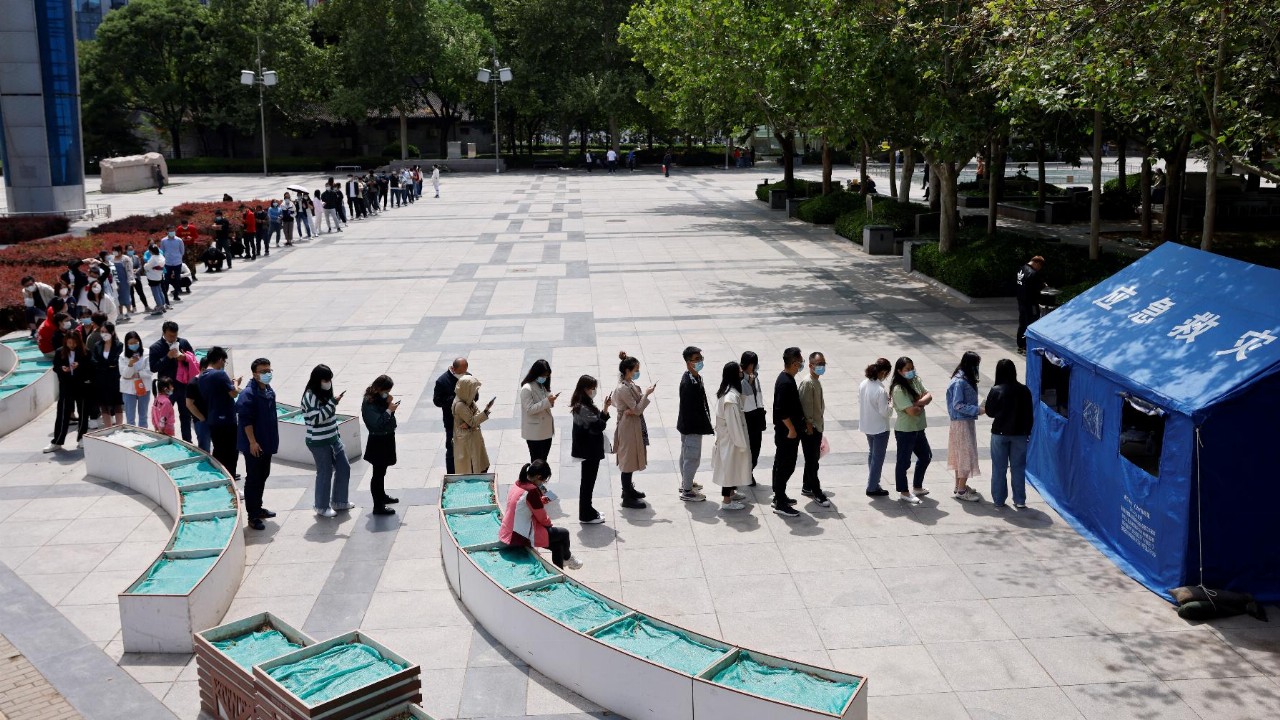
The Chinese government ordered tens of millions of people into lockdown last month, with restrictions in some areas lasting for weeks.
With the lockdowns came restricted activities in many key parts of the country, including the central business hub of Shanghai.
China’s leaders last week doubled down on the country’s zero-COVID approach, raising fears of a sharp economic downturn in the world’s second-largest economy that could weigh on global growth, which is already under threat by Russia’s military action in Ukraine.
China’s national jobless rate is at a near two-year high, and Reuters said some analysts were warning of increasing recession risks unless Beijing relaxes its strict COVID policies.